
What Is AP Seminar? The 5 Big Ideas That Help Students Develop University-Level Academic Thinking
AP Seminar, part of the College Board's AP Capstone programme, trains critical thinking, research and academic argument rather than memorisation.
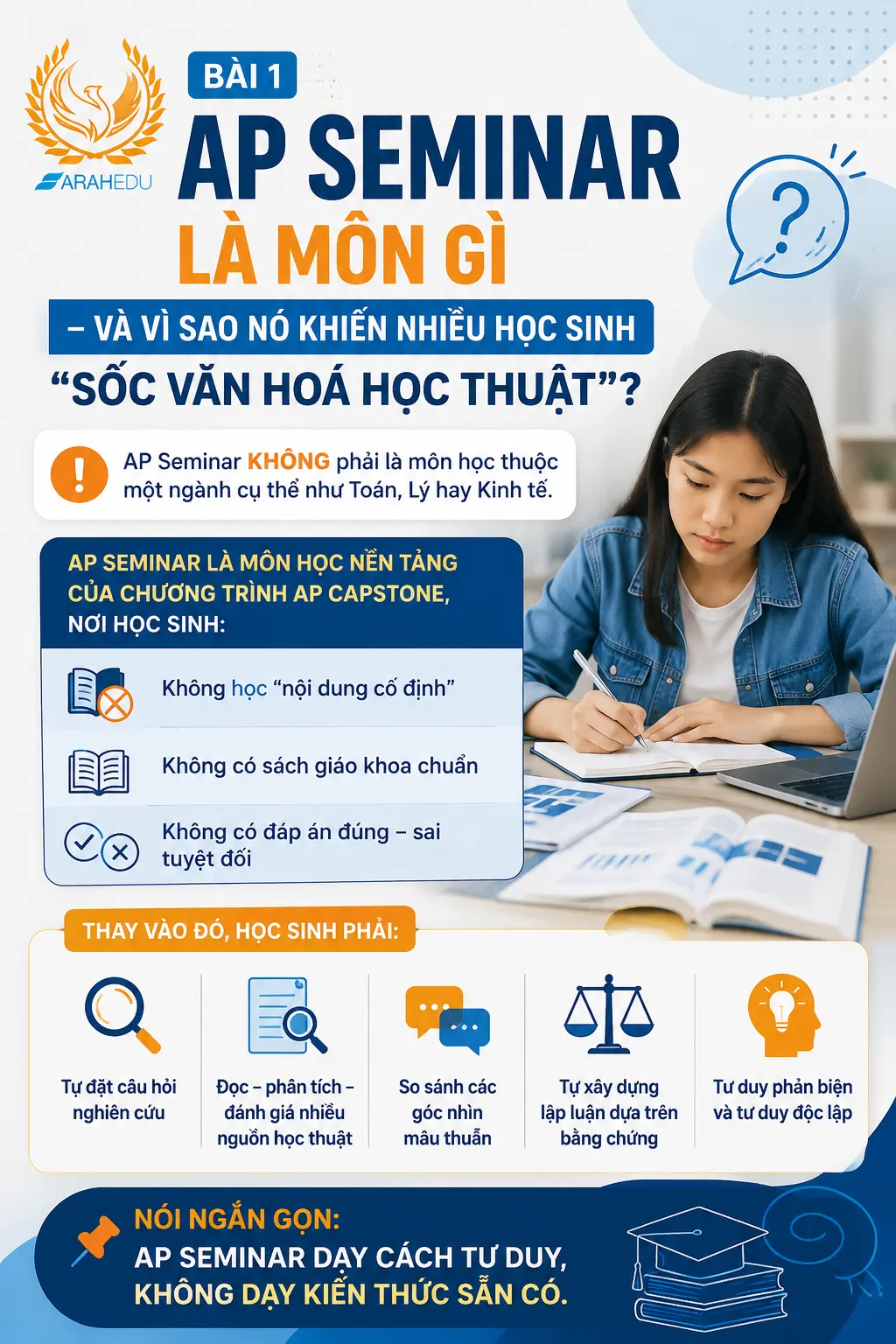
AP Seminar is one of the most distinctive courses in the College Board’s AP Capstone programme. Rather than focusing on memorising knowledge or solving problems using standardised methods, AP Seminar helps students develop critical thinking, research, information analysis, and academic argumentation skills – all of which are highly valued by leading universities around the world.
So, what is AP Seminar, what do students learn, and why is it considered an important stepping stone before entering university? Let’s explore this course with Sarah Education in the article below.
What Is AP Seminar?
Unlike traditional AP subjects such as AP Calculus, AP Physics, or AP Economics, AP Seminar does not belong to any single academic discipline.
It is a foundational course in the AP Capstone programme, designed to help students approach academic issues through research and critical thinking.
In AP Seminar:
- There is no fixed textbook.
- There is no single correct answer.
- Students do not simply memorise information; they learn how to find, evaluate, and use information independently.
Instead, students learn to:
- Develop their own research questions.
- Read and analyse a range of academic sources.
- Evaluate contrasting viewpoints.
- Build arguments supported by credible evidence.
In other words, AP Seminar does not teach students simply “what to think”, but rather “how to think”.
Image
The 5 Big Ideas – The Core Thinking Framework of AP Seminar
The entire AP Seminar course is built around five Big Ideas. These are not chapters of content to memorise, but five key areas of academic skill development that students work on throughout the course.
1. Question and Explore
Students learn how to ask meaningful research questions, rather than simply look for answers to questions that have already been provided.
A strong research question opens up multiple avenues for analysis and provides the foundation for the entire research process.
2. Understand and Analyze
Students must fully understand an author’s argument before evaluating or challenging it.
They develop skills in:
- Analysing the structure of an argument.
- Identifying the main claims.
- Evaluating the evidence used.
3. Evaluate Multiple Perspectives
Academic issues rarely have just one point of view.
In AP Seminar, students are expected to:
- Compare different perspectives.
- Analyse the strengths and limitations of each argument.
- Understand why different approaches may lead to different conclusions.
4. Synthesize Ideas
This involves connecting information from multiple sources to develop an independent perspective.
It is fundamentally different from simply copying or combining ideas from different materials.
5. Team, Transform and Transmit
In addition to conducting research, students are also expected to:
- Collaborate effectively in teams.
- Present their research findings.
- Communicate academic ideas clearly and persuasively.
AP Seminar places greater emphasis on the thinking process than on memorising information.
How Is AP Seminar Different from IELTS Writing and Other Essay-Based Courses?
This is a very common question among students.
Many students assume that being good at writing essays in English will make AP Seminar easy. In reality, this is not necessarily the case.
Some of the key differences include:
- IELTS Writing generally requires students to respond to a given prompt, whereas AP Seminar requires them to identify and develop their own research questions.
- Examples in IELTS Writing are primarily used for illustration, while AP Seminar requires students to draw on credible academic sources.
- Students’ personal viewpoints in AP Seminar must be developed and supported through research and evidence.
- Students are expected to evaluate multiple perspectives before reaching a conclusion.
In addition, AP Seminar requires students to:
- Develop a line of reasoning (a logical sequence of arguments).
- Evaluate the credibility of sources.
- Identify potential biases and limitations in individual sources.
These are all skills commonly expected of students from their first year at university.
The Two Key Performance Tasks in AP Seminar
AP Seminar scores are not based solely on the end-of-course exam. They also include two important Performance Tasks.
Performance Task 1 (Team Project and Presentation)
Students are required to:
- Investigate a real-world issue.
- Collaborate with other members of their team.
- Deliver a presentation.
- Complete an individual written report.
The greatest challenge is not simply working in a team, but developing a coherent academic approach that brings together the perspectives and ideas of all team members.
Performance Task 2 (Individual Research-Based Essay and Presentation)
In this component, students must:
- Write an individual research paper.
- Develop an argument based on the provided source materials.
- Defend their position using relevant evidence.
This component is particularly important in distinguishing students’ levels of achievement and provides a foundation for progressing to AP Research.
Is There an End-of-Course Exam for AP Seminar?
The answer is Yes.
However, the AP Seminar end-of-course exam does not require students to memorise subject knowledge.
Instead, students are expected to:
- Analyse unfamiliar source materials.
- Develop academic arguments within a limited time.
- Evaluate and challenge different perspectives.
This means that practising exam questions alone is not enough to achieve a high score if students have not developed a strong foundation in academic thinking.
Why Should Students Take AP Seminar?
An increasing number of universities value students who demonstrate strong research skills and independent thinking.
AP Seminar helps students:
- Develop critical thinking skills.
- Build proficiency in academic research.
- Improve their ability to read and analyse English-language materials.
- Gain confidence in presentations and teamwork.
- Establish a foundation for AP Research and international university programmes.
AP Seminar can also help strengthen a university application, particularly for students interested in Economics, Social Sciences, Communications, International Relations, and other interdisciplinary fields.
Study AP Seminar with Sarah Education
At Sarah Education, students receive structured guidance in:
- Academic research methods.
- Analysing and evaluating sources.
- Developing logical arguments in line with AP expectations.
- Preparing for Performance Tasks and the end-of-course exam.
If you are looking for a programme that develops academic thinking and helps prepare you for leading universities around the world, AP Seminar is certainly worth considering.
Contact Sarah Education today to receive advice on an AP study pathway tailored to your goals.