8 EFFECTIVE TIPS FOR STUDYING AND TEACHING TOK (FOR STUDENTS & TEACHERS)
8 EFFECTIVE TIPS FOR STUDYING AND TEACHING TOK (FOR STUDENTS & TEACHERS)
“TOK feels too abstract… How can I study it effectively?”
Here are eight practical strategies widely used in international schools to make learning and teaching TOK more engaging and effective.
1. Start with Real-Life Experiences
TOK is not simply a collection of abstract theories. Connect it to real-world issues such as:
- Misinformation and fake news.
- Media and communication.
- Technology.
- Ethical controversies.
- Different interpretations of textbooks.
Knowledge becomes easier to understand when it is connected to everyday life.
2. Use Knowledge Questions EVERYWHERE
Every learning activity should begin with questions that encourage students to think about knowledge, such as:
- “How do we know this?”
- “Who has the authority to decide what is true?”
- “What are the limitations of this knowledge?”
3. Keep a TOK Diary for 10 Minutes Every Week
Students can write short reflections on:
- One piece of knowledge they encountered during the week.
- Where that knowledge came from.
- Any potential biases associated with it.
This is one of the simplest ways to develop TOK thinking skills consistently.
4. Practise Essay Writing by Analysing Introductions
Students do not always need to write an entire essay to improve their skills. Start by analysing the introductions of five previous TOK essay titles.
Understanding what a question is asking is already a major step towards writing a successful essay.
5. Teach TOK Through Images, Pictures and Videos
Knowledge:
- Is always shaped by perspectives.
- Is often subject to interpretation.
Visual materials can therefore be highly effective teaching tools.
Examples:
- One chart → three different interpretations.
- One painting → four different perspectives.
6. Compare Two AOKs – One of the Most Important Essay Skills
A simple template students can remember and apply:
“In AOK X, knowledge is strong because ______.
However, in AOK Y, knowledge depends on ______.
This suggests that…”
This structure encourages students to compare Areas of Knowledge (AOKs) rather than simply describe them separately.
7. Prepare for the TOK Exhibition by Analysing Each Other’s Objects
Organise students into groups of three or four. Each student brings one object, and the group analyses one another’s choices.
This collaborative approach makes it easier for students to explore different perspectives, exchange ideas and remember key concepts.
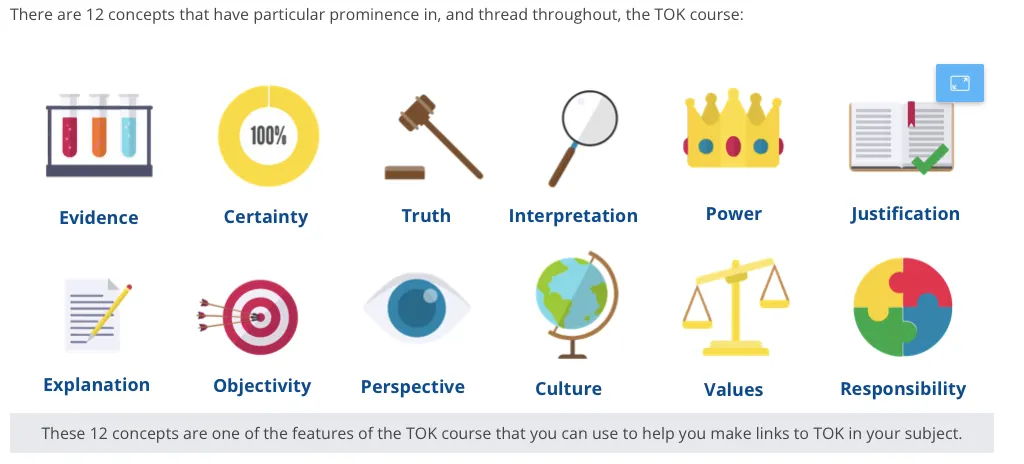
8. Focus on the 12 TOK Key Concepts
The 12 key concepts provide a framework for developing deeper TOK analysis across different topics.
Some particularly useful concepts include:
- Evidence.
- Justification.
- Interpretation.
- Power.
- Perspective.
- Responsibility.
Using these concepts accurately and meaningfully can make students’ arguments more insightful and sophisticated.
Would you like Sarah Education to help you choose a suitable TOK essay or exhibition topic? Send us a message to receive guidance from our team of academic specialists!