CORE THEME: KNOWLEDGE & THE KNOWER
CORE THEME: KNOWLEDGE & THE KNOWER
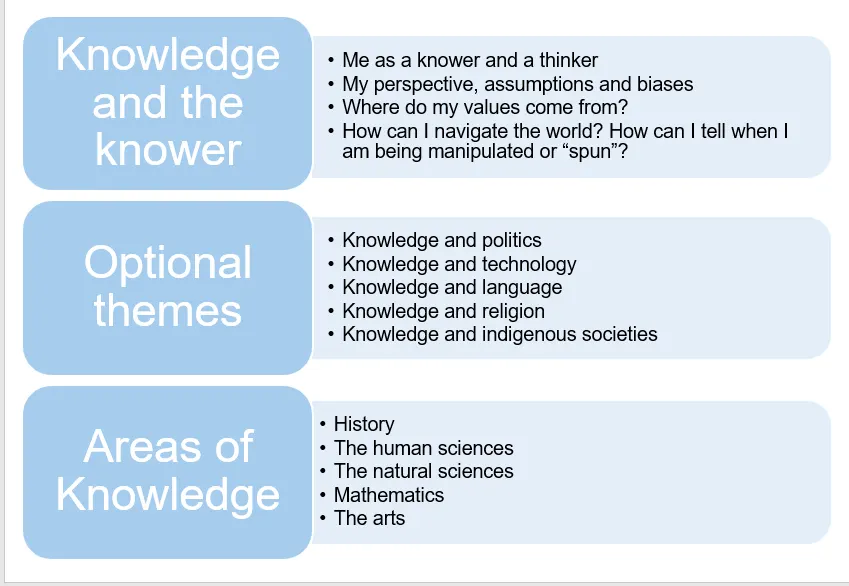
The Core Theme is the foundation of the entire TOK course. Students begin by exploring themselves as knowers and examining how they acquire, interpret and share knowledge.
1. Who Is a “Knower”?
A knower is:
- An individual who holds beliefs and possesses knowledge.
- Someone whose understanding is shaped by personal experiences, emotions and culture.
- Someone who interacts with the surrounding communities of knowers.
- Someone influenced by technology, media and education.
- Someone with ethical responsibilities when sharing knowledge.
2. Key Questions of the Core Theme
- How do I know what I claim to know?
- What do I believe, and why do I believe it?
- Where do my beliefs come from?
- Do personal experiences help or hinder the process of knowing?
- Can communities influence me to develop biases?
- Is technology shaping the way I perceive and understand the world?
3. Four Elements of Analysis (Knowledge Framework)
Scope
The Core Theme encourages students to:
- Explore how individuals and communities develop knowledge.
- Examine the conditions under which beliefs are formed.
- Evaluate the limitations of individual perspectives.
Example:
“If I had been born into a different culture, would I hold the same beliefs?”
Perspectives
Every individual and community of knowers has certain characteristics that influence how they perceive the world, including:
- Values.
- Beliefs.
- Assumptions.
- Biases.
- Traditions.
Example TOK Question:
“Is there any knowledge that is entirely objective?”
Methods & Tools
The Core Theme encourages students to analyse:
- How does technology shape knowledge?
- How can tools such as maps, data and algorithms introduce bias?
- Are our methods of reasoning reliable?
Examples:
- Do TikTok and YouTube algorithms create one-sided perspectives among viewers?
- Can Artificial Intelligence (AI) be considered a “knower”?
Ethics
Key ethical questions include:
- What responsibilities do I have when sharing knowledge?
- When can knowledge become harmful?
- Should misinformation be regulated?
Examples:
- Does the use of deepfakes (AI-generated manipulated videos or other synthetic media) raise ethical concerns about knowledge?
- Should dangerous information be restricted in the interests of the wider community?
4. Suggested Practical Activities
- Bias Test: Students examine five online news stories and identify and classify potential biases.
- Perspective Circle: Four students independently describe the same image and then compare their different interpretations.
- Epistemic Diary: Students record their daily reflections on the question: “What did I believe today, and why?”
5. How Is the Core Theme Connected to the TOK Exhibition?
Many TOK Exhibition prompts can be explored through ideas related to the Core Theme, for example:
- “What counts as knowledge?”
- “Are some types of knowledge less open to interpretation than others?”
- “How can we distinguish knowledge from opinion?”
The Core Theme helps students:
- Select relevant and meaningful objects more effectively.
- Develop deeper and more insightful exhibition commentaries.
- Analyse individual and collective perspectives more critically.
Would you like Sarah Education to help you choose a suitable TOK essay or exhibition topic? Send us a message to receive guidance from our team of academic specialists!