UNDERSTANDING DIGITAL SAT SCORING – WHAT YOU NEED TO KNOW
UNDERSTANDING DIGITAL SAT SCORING – WHAT YOU NEED TO KNOW
PART 1: How Is the Digital SAT Scored? Understanding Item Response Theory (IRT) to Maximise Your Score!
Have you ever wondered how SAT scores are calculated? Why can two students get the same number of questions correct but receive different scores? The answer lies in Item Response Theory (IRT) – a measurement method that evaluates student ability based on the characteristics and difficulty of individual questions. Let’s take a closer look!
1. An Overview of SAT Scoring
The SAT consists of two main sections:
- Reading and Writing (R&W)
- Math
Each section is scored on a scale of 200–800, giving a total SAT score ranging from 400–1600.
However, the score you receive (for example, 1350/1600) is not simply a count of the number of correct answers. Behind the final score is a more sophisticated scoring process based on Item Response Theory (IRT), which plays a central role in the scoring system.
- Step 1: Calculate the score for each section (Raw Score → Scaled Score).
- Step 2: Apply IRT to account for the characteristics and difficulty of the questions.
2. Item Response Theory (IRT) – The “Secret” Behind SAT Scores
IRT is a mathematical model used to evaluate a test-taker’s ability based on the characteristics of individual questions, rather than simply counting the number of correct and incorrect answers.
The Basic Principles of IRT
Each question can be characterised by three main parameters:
- Difficulty: How challenging the question is.
- Discrimination: How effectively the question distinguishes between students with different ability levels.
- Guessing: The probability of answering correctly by chance (for example, 25% for a four-option multiple-choice question).
Examples:
- If you answer many difficult and highly discriminating questions correctly, the system indicates that you have a higher level of ability, potentially resulting in a higher score.
- If you answer mostly easy questions correctly, IRT may indicate a more moderate level of ability, resulting in a smaller score increase, even if your total number of correct answers is relatively high. This is because questions may contribute differently to the scoring process depending on their characteristics.
3. How Is the SAT Score Calculated?
Step 1: Calculate the Raw Score
- Math: Each correct answer = +1 point; incorrect or unanswered questions = 0 points.
- Reading and Writing: Each correct answer = +1 point, although the characteristics of individual questions are also taken into account through IRT.
Step 2: Convert the Raw Score into a Scaled Score (200–800)
- The Raw Score is converted into a Scaled Score using a conversion model that may vary across test forms to account for differences in difficulty.
- IRT helps maintain scoring fairness: students taking a more challenging test form may still achieve a high Scaled Score even if they answer fewer questions correctly.
Step 3: Calculate the Total SAT Score
Example:
- Math: Raw Score: 40 → Scaled Score: 590
- Reading and Writing: Raw Score: 40 → Scaled Score: 530
→ Total SAT Score: 1120
Coming Soon: Stay tuned for our next article, where we will analyse a practical example of how Digital SAT scores are calculated!
PART 2: A PRACTICAL ANALYSIS OF DIGITAL SAT SCORING
The Digital SAT uses multistage adaptive testing and Item Response Theory (IRT), which means that the same number of correct answers may result in different scores across different test forms.
Let’s explore this through a comparison of Practice Test 4 and Practice Test 8.
1. Step-by-Step Scoring Process
Step 1: Calculate the Number of Correct Answers (Raw Score)
Step 2: Convert the Number of Correct Answers into a Scaled Score (Raw Score → Scaled Score)
- Raw Score: The number of correctly answered questions in each section. No points are deducted for incorrect or unanswered questions.
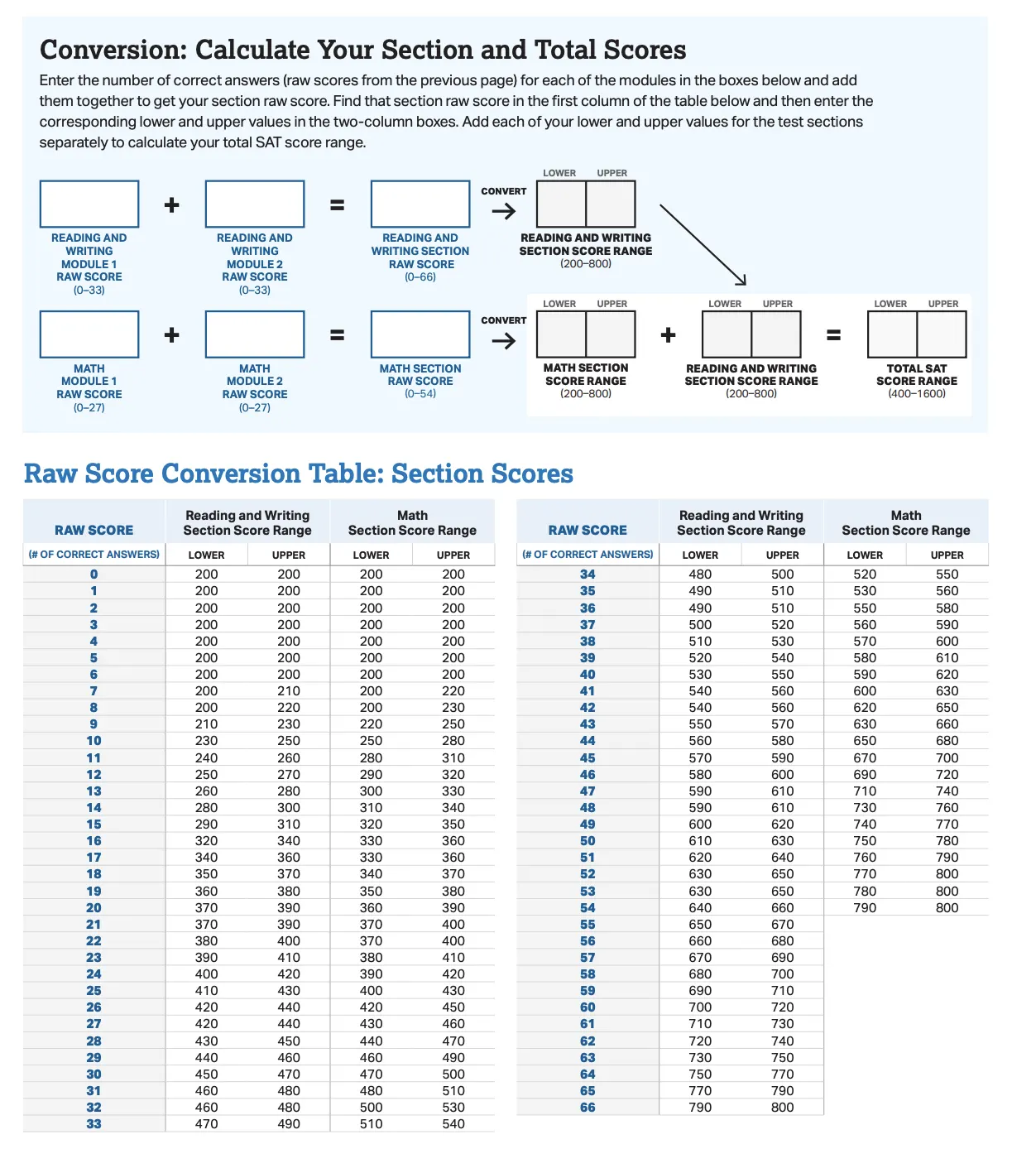
- A conversion table or scoring model is used to convert the Raw Score into a Scaled Score (on a scale of 200–800) for each section:
- Reading and Writing: Add the Raw Scores from both modules, then refer to the corresponding conversion table.
- Math: Add the Raw Scores from both modules, then refer to the corresponding conversion table.
Example (based on Practice Test 4):
- If you answer all 54 Math questions correctly (54/54), your Scaled Score may range from 790–800.
- If you answer 40 out of 66 Reading and Writing questions correctly, your Scaled Score may range from 530–550.
The reasons behind these score ranges will be explained in greater detail below.
Step 3: Calculate the Total SAT Score
Add the Scaled Scores from the two sections:
- Reading and Writing (maximum: 800)
- Math (maximum: 800)
2. Comparing Scaled Scores: Practice Test 4 vs. Practice Test 8
a. Reading and Writing (R&W)
| Raw Score | Practice Test 4 (Scaled) | Practice Test 8 (Scaled) | | 30 | 450–470 | 410–450 | | 40 | 530–550 | 490–550 | | 50 | 610–630 | 590–650 |
Key Observations:
- At the same Raw Score, Practice Test 8 appears to produce Scaled Scores approximately 20–40 points lower than Practice Test 4 in some cases.
- One possible explanation is that the overall difficulty of Test 8 may differ from that of Test 4. College Board uses scoring adjustments to maintain fairness across different test forms.
b. Math
| Raw Score | Practice Test 4 (Scaled) | Practice Test 8 (Scaled) | | 30 | 470–500 | 470–510 | | 40 | 590–620 | 570–630 | | 50 | 750–780 | 740–780 |
Key Observations:
- Similar to Reading and Writing, Math scores on Test 8 may also be slightly lower than those on Test 4 at certain Raw Scores.
- However, the differences are relatively small overall, suggesting that the two Math test forms may have broadly comparable difficulty levels.
3. Why Do SAT Scores Differ?
a. The Adaptive Nature of the Test
- Module 1: Has a common level of difficulty and helps determine whether a student receives an easier or more difficult Module 2.
- If you perform well in Module 1, you will receive a more difficult Module 2. Your Raw Score may be lower, but your Scaled Score can still be higher.
Example:
- Test 4 Math: Raw Score of 30 → Scaled Score of 470 (easier Module 2) or 500 (harder Module 2).
- Test 8 Math: Raw Score of 30 → Scaled Score of 470 (easier Module 2) or 510 (harder Module 2).
b. The Overall Difficulty of the Test
- College Board uses scoring adjustments to account for differences in test difficulty and maintain consistency across different test forms.
- Test 8 may be perceived by students as easier than Test 4, but its Scaled Scores may differ as a result of the scoring adjustments applied to that particular test form.
4. Understanding “Lower” and “Upper” in SAT Score Conversion Tables
- Lower: The minimum score you may receive for a given Raw Score.
- Upper: The maximum score you may receive for that same Raw Score.
- The Range Between Lower and Upper: Illustrates the possible variation in scores associated with different test forms and adaptive testing pathways.
Why Is There a Score Range Instead of One Fixed Score?
The Digital SAT uses adaptive testing, meaning that:
- Module 1 in each section (Reading and Writing or Math) begins at a common level of difficulty.
- Module 2 adjusts its difficulty based on your performance in Module 1:
- If you perform well in Module 1 → You receive a more difficult Module 2 → You may achieve a higher score for the same total number of correct answers.
- If you do not perform as well in Module 1 → You receive an easier Module 2 → You may achieve a lower score for the same total number of correct answers.
Where Will Your Final Score Fall Within the Lower–Upper Range?
Although College Board does not publicly disclose its complete scoring algorithm, a general interpretation is:
- If you receive the more difficult Module 2, your score may be closer to the Upper end of the range.
- If you receive the easier Module 2, your score may be closer to the Lower end of the range.
Your official SAT Score Report will show one specific score, rather than a range like the illustrative examples in the tables above.
5. Important Note
- There is no penalty for incorrect answers: Leaving a question blank and answering it incorrectly both result in zero points. Therefore, if you are unsure of an answer, it is always better to make an educated guess rather than leave it blank!
6. Strategies to Maximise Your SAT Score by Understanding IRT
The more questions you answer correctly, the better. Focus on securing easier questions first before moving on to more challenging ones.
Smart test-taking strategies:
- Aim to perform strongly in Module 1 to increase your chances of receiving the more difficult Module 2.
- Prioritise accuracy across all questions, especially those that provide strong evidence of your subject knowledge and ability.
Practise using adaptive testing platforms such as Bluebook and Khan Academy to become familiar with the Digital SAT format and testing experience.
Conclusion
Understanding IRT helps you see why Digital SAT scores are calculated the way they are and how to develop more effective test-taking strategies.
Practise strategically, make the most of your preparation, and approach your SAT goals with confidence!
Do you have any questions about how SAT scoring works? Leave a comment below and join the discussion with Sarah Education!