International School Tuition Fees in Ho Chi Minh City for the 2025–2026 Academic Year: A Detailed Analysis and Guide for Parents
International School Tuition Fees in Ho Chi Minh City for the 2025–2026 Academic Year: A Detailed Analysis and Guide for Parents
Ho Chi Minh City has the largest concentration of international schools in Vietnam and offers one of the most diverse ranges of international education models in the country. These include bilingual schools, integrated education institutions, and fully international schools offering Cambridge, International Baccalaureate (IB), or national curricula from the United Kingdom, Australia, and Canada.
The rapid expansion of the international school sector has provided parents with a wider range of educational options. However, it also raises an important question:
How much do international schools in Ho Chi Minh City currently charge, and which option is the most suitable for each family?
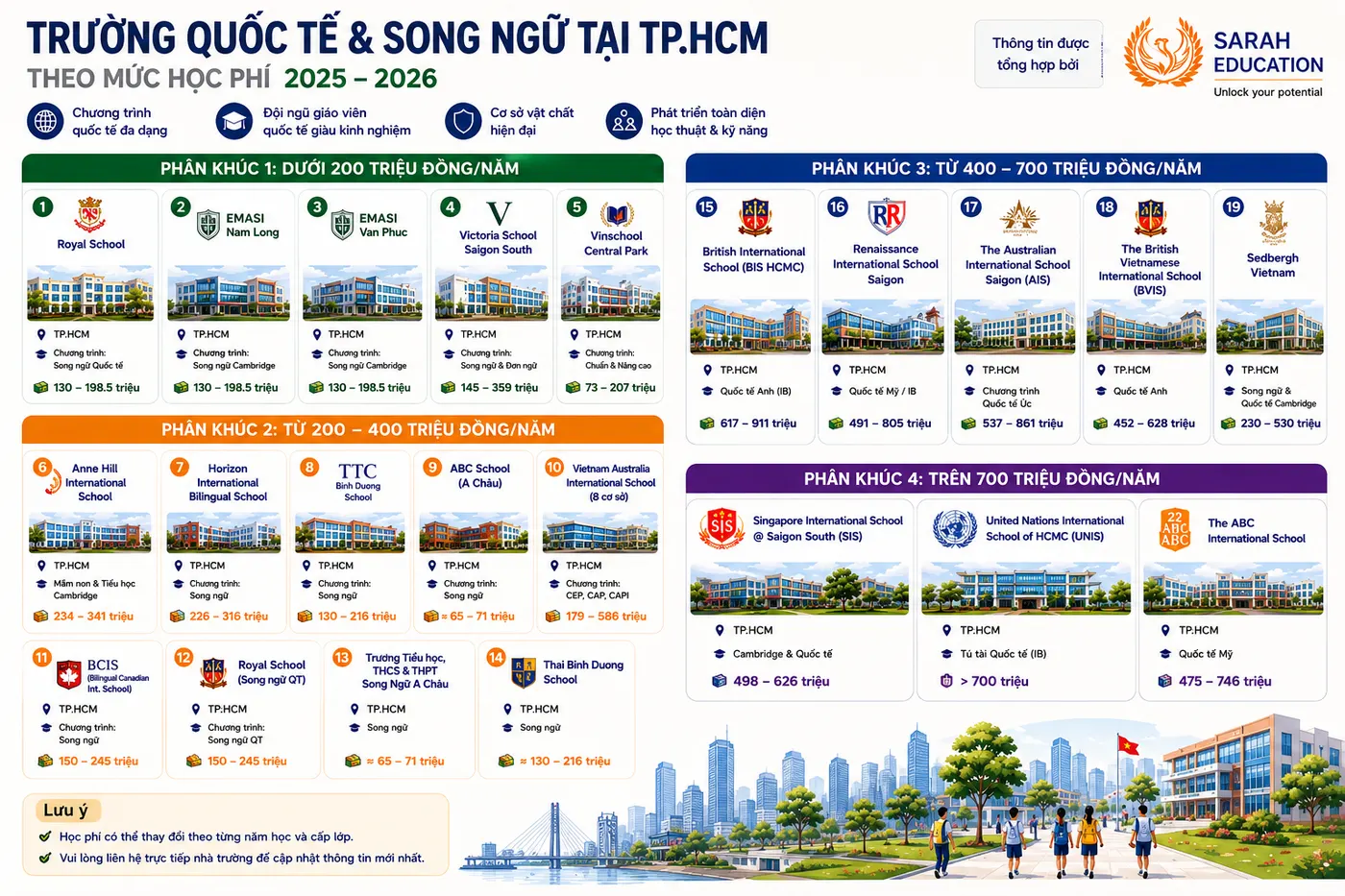
According to Sarah Education’s survey, annual tuition fees at international schools in Ho Chi Minh City currently range from approximately VND 70 million to nearly VND 1 billion, reflecting substantial differences in educational costs, school models, and academic offerings.
Overview of International School Tuition Fees in Ho Chi Minh City for the 2025–2026 Academic Year
While annual tuition fees exceeding VND 500 million are generally associated with only a limited number of premium international schools in Hanoi, this fee range is considerably more common in Ho Chi Minh City.
Based on tuition fee data for the 2025–2026 academic year, international schools in Ho Chi Minh City can be broadly classified into four main categories:
- Below VND 150 million per year;
- VND 150–300 million per year;
- VND 300–500 million per year;
- Above VND 500 million per year.
The gap between the lowest and highest tuition fee brackets exceeds tenfold, reflecting significant differences in educational models, teaching staff, facilities, and academic pathways.
Schools with Annual Tuition Fees Below VND 150 Million
This segment is suitable for families seeking access to international education while maintaining a manageable education budget.
Representative schools include:
- Vinschool Central Park – Standard Programme: approximately VND 73–95 million per year.
- Victoria School – Bilingual International Programme (Primary Level): from VND 145 million per year.
- TTC School: approximately VND 130–216 million per year, depending on the educational level.
Advantages
- Relatively affordable tuition fees.
- Students gain access to bilingual learning environments and international curricula.
- Opportunities to study both the Vietnamese national curriculum and Cambridge programmes.
Limitations
- A relatively lower proportion of international teachers.
- A limited international student population.
- Less prominent multicultural learning environments compared with fully international schools.
This category is a suitable option for families seeking an international education pathway for their children while maintaining a reasonable balance between educational investment and household finances.
Schools with Annual Tuition Fees of VND 150–300 Million
This is one of the fastest-growing segments of the international education market in Ho Chi Minh City in recent years.
Representative schools include:
- EMASI
- Royal School
- Vietnam Australia School (VAS) – CEP and CAP programmes.
- Horizon International Bilingual School
- Sedbergh Vietnam – Bilingual Programme.
Key Characteristics
- Greater exposure to English throughout the school day.
- More structured implementation of Cambridge programmes.
- Opportunities to participate in extracurricular activities and academic projects.
- Modern learning facilities and educational infrastructure.
This segment is particularly popular among middle-income and upper-middle-income families in Ho Chi Minh City, thanks to its balance between tuition costs and educational quality.
Schools with Annual Tuition Fees of VND 300–500 Million
This category comprises schools with a higher degree of internationalisation, making them suitable for families with early overseas university aspirations for their children.
Representative schools include:
- Victoria School – High School Level.
- Sedbergh Vietnam – Cambridge Programme.
- Vietnam Australia School (VAS) – Full International Integrated Programme (CAPI).
- Singapore International School – Cambridge International Programme.
- The ABC International School – Primary Level.
Key Differentiating Features
An English-Rich Learning Environment
English is used extensively in academic activities and everyday communication, allowing students to develop their language proficiency through continuous exposure.
Internationally Oriented Academic Curricula
Students receive stronger preparation for internationally recognised qualifications such as IGCSE, A Level, and the International Baccalaureate (IB).
A Higher Proportion of International Teachers
Many schools employ a substantial number of internationally qualified teachers to deliver their academic programmes.
University and Career Guidance
Students receive early guidance on academic interests, prospective university pathways, and the development of competitive university application profiles.
Schools with Annual Tuition Fees Above VND 500 Million
This represents the premium segment of the international school market in Ho Chi Minh City.
Representative schools include:
- British International School Ho Chi Minh City (BIS)
- British Vietnamese International School (BVIS)
- Australian International School (AIS)
- Renaissance International School Saigon
- Singapore International School – A Level Programme.
- ABC International School
Annual tuition fees in this category range from approximately VND 500 million to nearly VND 1 billion.
Why Are Tuition Fees Significantly Higher in This Segment?
A Fully International Learning Environment
Students from diverse nationalities and cultural backgrounds create a multicultural learning environment, where English serves as the primary language of instruction and communication.
International Teaching Faculty
A substantial proportion of teachers come from the United Kingdom, Australia, the United States, and other English-speaking countries.
International-Standard Facilities
Theatres, arts centres, science laboratories, sports facilities, swimming pools, and modern library systems are among the key features contributing to higher tuition fees.
Comprehensive University Admissions Support
Many schools have dedicated university counselling departments that guide students in developing competitive applications to leading universities worldwide.
Why Do International School Tuition Fees in Ho Chi Minh City Vary So Significantly?
Many parents wonder why some schools charge approximately VND 100 million per year, while others have annual tuition fees approaching VND 1 billion.
These differences are primarily attributable to five key factors.
1. Educational Models
Bilingual schools generally have lower operating costs and tuition fees than fully international schools, as their curricula, teaching arrangements, and language requirements differ.
2. Proportion of International Teachers
The composition of the teaching faculty is one of the most significant factors influencing tuition fees, particularly when schools employ a large number of internationally recruited teachers.
3. Class Sizes
Smaller class sizes allow for more individual attention and greater interaction between teachers and students. However, they also increase operational costs per student.
4. Facilities and Student Support Services
School bus services, university counselling, extracurricular programmes, sports, arts, and other student support services can all contribute substantially to overall educational costs.
5. School Reputation and Graduate Outcomes
Schools with established reputations and strong university admission outcomes, particularly in relation to leading universities worldwide, often charge considerably higher tuition fees.
How Should Parents Choose the Right International School?
There is no single school that is the best choice for every student.
The decision should be based on several important considerations:
- The child’s academic ability and learning needs;
- Current English proficiency;
- Long-term university and career aspirations;
- The family’s long-term financial capacity;
- The type of learning environment parents wish to provide.
For Families with an Annual Budget Below VND 200 Million
Parents may consider the following schools:
- Vinschool;
- Victoria School;
- Royal School;
- TTC School.
For Families with an Annual Budget of VND 200–400 Million
The following schools may be worth considering:
- EMASI;
- Horizon International Bilingual School;
- Vietnam Australia School;
- Sedbergh Vietnam.
For Families with Early Overseas University Aspirations
Parents may explore the following schools:
- BIS;
- BVIS;
- AIS;
- Renaissance International School Saigon;
- Singapore International School;
- ABC International School.
Projected Trends in International School Tuition Fees in Ho Chi Minh City
Over the past three years, most international schools in Ho Chi Minh City have demonstrated an upward trend in tuition fees, with annual increases generally ranging from 5% to 10%.
This trend is driven by several factors:
- Rising costs of internationally recruited teaching staff;
- Growing demand for international education;
- Continued investment in school facilities and infrastructure;
- Increasing expectations regarding the quality of educational services.
As a result, parents should develop a long-term financial plan when considering an international education pathway extending from primary school through to the completion of upper secondary education.
The total investment in a 12-year educational journey at an international school may range from over VND 1 billion to more than VND 10 billion, depending on the school’s educational model and the student’s chosen academic pathway.
Conclusion
Ho Chi Minh City currently has the most developed international education ecosystem in Vietnam, offering a wide range of schooling options across different tuition fee brackets and educational models.
However, tuition fees alone should not determine the quality of an educational institution. More importantly, parents should identify a school that aligns with their child’s academic abilities, educational objectives, and long-term aspirations.
Making the right choice from the outset can help families optimise their educational investment while establishing a strong foundation for future academic development and international university admissions.
Sarah Education is committed to supporting parents in identifying suitable international schools, developing personalised academic pathways, and providing effective overseas education guidance tailored to each student’s individual needs.