A LEVEL MATHEMATICS EXAMINATION OPTIONS (FOR THE 2025 EXAMINATION SESSION)
A LEVEL MATHEMATICS EXAMINATION OPTIONS (FOR THE 2025 EXAMINATION SESSION)
1. Introduction to A Level Mathematics Examination Options
If you are preparing for A Level Mathematics, choosing the right examination combination is an important step towards achieving the best possible results. In this article, we provide an overview of the available examination options to help you better understand and make an informed decision about your choices.
A Level Mathematics (9709) is divided into two stages: AS Level (Year 1) and A Level (Year 2). Depending on your academic goals, you may choose to sit only the AS Level examinations or continue your studies and complete the full A Level qualification.
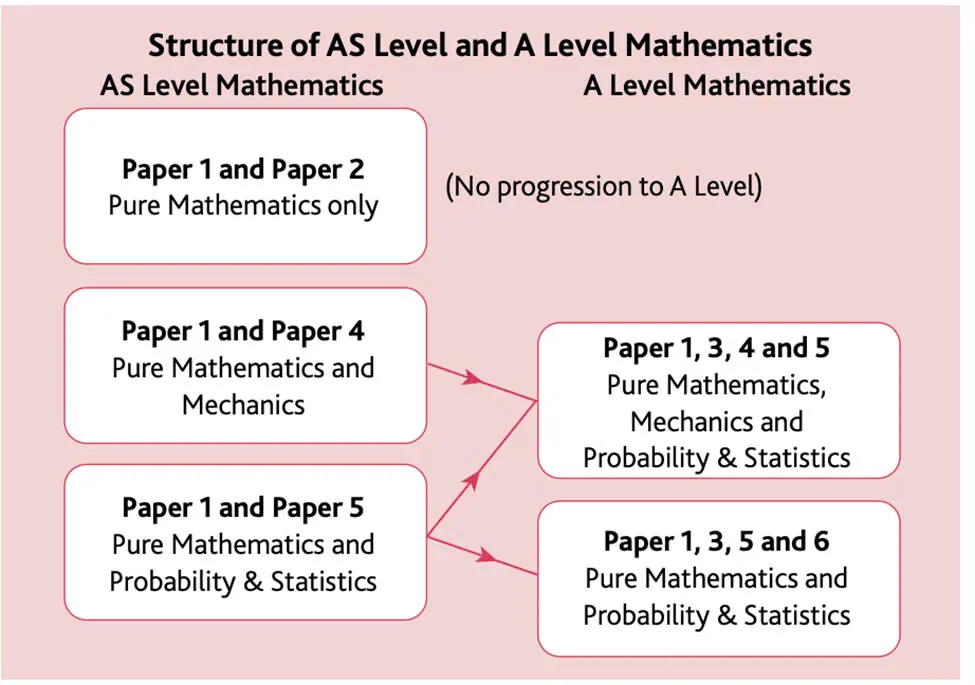
The syllabus covers three main areas: Pure Mathematics, Mechanics, and Probability & Statistics, with six examination papers (Papers 1–6) in total. These are arranged into the following examination combinations:
- AS Level: Students are required to sit two examination papers. There are three available options, from which students must choose one:
- Pure Mathematics 1 + Pure Mathematics 2: Focuses exclusively on Pure Mathematics.
- Pure Mathematics 1 + Mechanics: Combines Pure Mathematics and Mechanics.
- Pure Mathematics 1 + Probability & Statistics 1: Combines Pure Mathematics with Probability & Statistics.
- A Level: Students are required to complete four examination papers in total, including the two papers taken at AS Level. There are two main examination combinations:
- Pure Mathematics 1 + Pure Mathematics 3 + Mechanics + Probability & Statistics 1
- Pure Mathematics 1 + Pure Mathematics 3 + Probability & Statistics 1 + Probability & Statistics 2
Important Considerations When Choosing an Examination Combination
- The Pure Mathematics 1 + Pure Mathematics 2 combination is available for AS Level only: If you choose this combination, you cannot progress to the full A Level qualification. If you intend to continue to A Level, you should select one of the other combinations.
- Mechanics (Paper 4) and Probability & Statistics 2 (Paper 6) cannot be combined: If you choose Mechanics at AS Level, you cannot select Probability & Statistics 2 at A Level. Make sure you consider this restriction carefully before making your decision.
- Pure Mathematics 1 and Pure Mathematics 3 are compulsory for A Level: Both papers are required to complete the full A Level qualification. Students must study and sit both examinations.
2. AS Level Examination Combination: Pure Mathematics 1 + Pure Mathematics 2
If you enjoy Pure Mathematics and do not intend to study Mechanics or Probability & Statistics in greater depth, the Pure Mathematics 1 + Pure Mathematics 2 combination may be a suitable option.
- Pure Mathematics 1: Covers the topics illustrated below. It provides an essential foundation for more advanced mathematical studies.
- Pure Mathematics 2: Builds on this foundation through more advanced topics, including Algebra, Logarithmic & Exponential Functions, and Integration.
Note:
This combination cannot be used to progress to the full A Level qualification. If you plan to continue to A Level, you should choose one of the other examination combinations.
3. AS Level Examination Combination: Pure Mathematics 1 + Mechanics
If you enjoy Mathematics and are interested in its practical applications in Physics, the Pure Mathematics 1 + Mechanics combination may be a suitable choice.
- Pure Mathematics 1: Provides the essential mathematical foundation.
- Mechanics: Focuses on topics such as Forces, Kinematics, Newton’s Laws of Motion, and Energy. These concepts are particularly important in Physics and Engineering.
Progression to A Level
Students can progress to the full A Level qualification by taking the following combination:
- Pure Mathematics 1 + Pure Mathematics 3 + Mechanics + Probability & Statistics 1.
Advantages:
- Combines Pure Mathematics and Mechanics, allowing students to develop a deeper understanding of how mathematical concepts are applied in real-world situations.
- Suitable for students planning to pursue degrees in Science, Engineering, or Physics.
Disadvantages:
- Mechanics may be challenging for students who have little interest in Physics.
If you enjoy Mathematics and want to explore its practical applications in Physics, this combination offers several advantages. However, you should carefully consider your interests and strengths before choosing it, particularly if you are not keen on Mechanics.
4. AS Level Examination Combination: Pure Mathematics 1 + Probability & Statistics 1
If you are interested in the applications of Mathematics in Economics, Finance, or Data Science, the Pure Mathematics 1 + Probability & Statistics 1 combination may be an ideal choice.
- Pure Mathematics 1: Provides the essential mathematical foundation.
- Probability & Statistics 1: Focuses on topics such as Representation of Data, Probability, and Discrete Random Variables. These concepts are important for data analysis and decision-making.
Advantages:
- Combines Pure Mathematics with Probability & Statistics, helping students develop their data analysis skills.
- Suitable for students planning to pursue degrees in Economics, Finance, or Data Science.
Disadvantages:
- Probability & Statistics may be challenging for students who have little interest in this area of Mathematics.
If you enjoy Mathematics and want to explore its practical applications in Economics or Data Science, this combination can offer valuable academic benefits.
5. A Level Examination Combination: Pure Mathematics 1 + Pure Mathematics 3 + Mechanics + Probability & Statistics 1
If you want to develop an in-depth understanding of both Pure Mathematics and its practical applications, the combination of Pure Mathematics 1 + Pure Mathematics 3 + Mechanics + Probability & Statistics 1 is a comprehensive option.
- Pure Mathematics 1 & 3: Provide a foundation in Pure Mathematics and develop more advanced mathematical knowledge.
- Mechanics: Focuses on the applications of Mathematics in Physics.
- Probability & Statistics 1: Covers data analysis and probability.
Advantages:
- Combines Pure Mathematics, Mechanics, and Probability & Statistics, providing students with a broad and well-rounded mathematical foundation.
- Suitable for a wide range of academic disciplines, from Science and Engineering to Economics and Finance.
Disadvantages:
- Requires considerable time and effort for studying and examination preparation.
- May be demanding for students who are not interested in both Mechanics and Probability & Statistics.
6. A Level Examination Combination: Pure Mathematics 1 + Pure Mathematics 3 + Probability & Statistics 1 + Probability & Statistics 2
If you are interested in the applications of Mathematics in Economics, Finance, or Data Science, the combination of Pure Mathematics 1 + Pure Mathematics 3 + Probability & Statistics 1 + Probability & Statistics 2 may be a suitable option.
- Pure Mathematics 1 & 3: Provide a foundation in Pure Mathematics and develop more advanced mathematical knowledge.
- Probability & Statistics 1 & 2: Explore Probability and Statistics in greater depth, including their applications in data analysis.
Advantages:
- Combines Pure Mathematics with Probability & Statistics, helping students develop strong data analysis skills.
- Suitable for students planning to pursue degrees in Economics, Finance, or Data Science.
Disadvantages:
- Does not include Mechanics, which may limit preparation for certain Science- or Engineering-related degree programmes.
If you enjoy Mathematics and wish to focus on its practical applications in Economics or Data Science, this combination can provide valuable academic benefits.