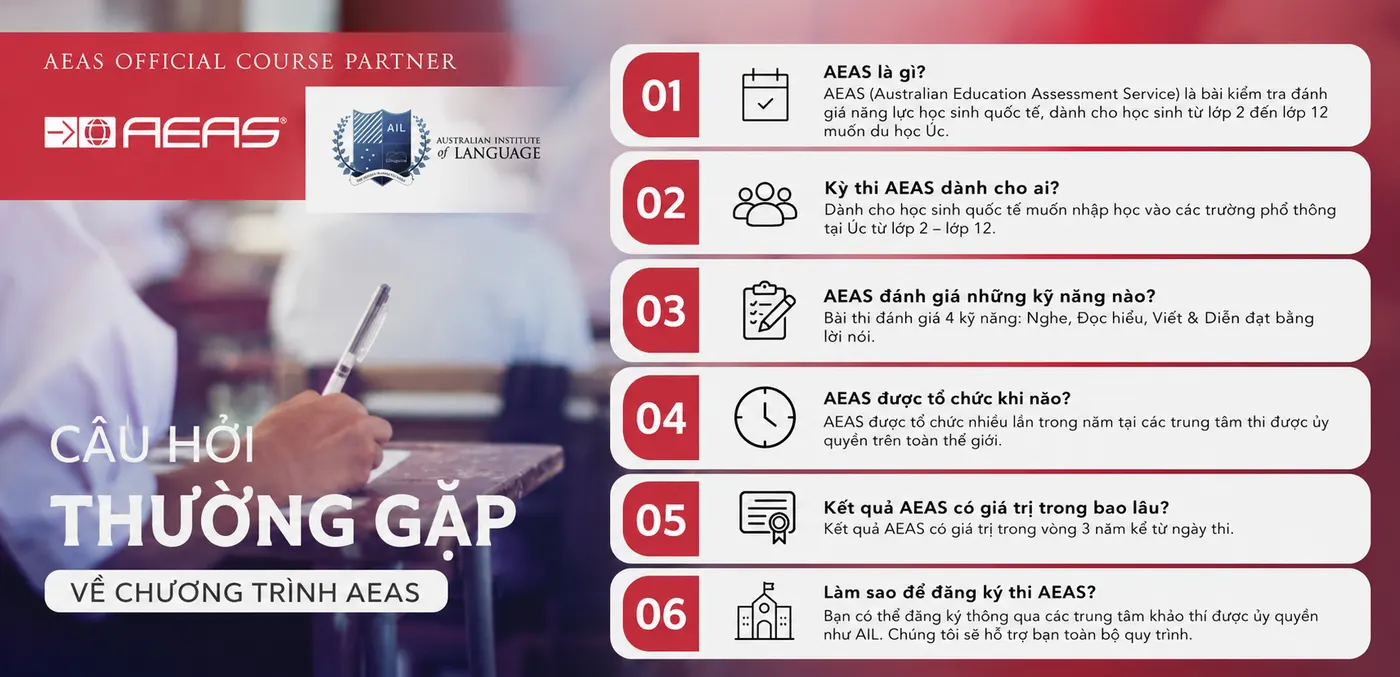
FREQUENTLY ASKED QUESTIONS ABOUT AEAS
FREQUENTLY ASKED QUESTIONS ABOUT AEAS
How Is the AEAS Test Developed?
The AEAS test is developed based on the Australian National Curriculum, textbooks, academic resources, and international assessment materials designed for school-aged students.
- AEAS conducts consultations and workshops with ESL (English as a Second Language) teachers to review and refine the test’s difficulty level, structure, and suitability.
- Each test version is trialled with actual students before being officially introduced.
AEAS Offers Three Separate Test Versions for Different Year Levels
- Years 4–6
- Years 7–9
- Years 10–12
This approach ensures that students are assessed appropriately according to their age, developmental stage, and cognitive and language abilities.
When Should Students Take the AEAS Test?
AEAS recommends that students sit the test 6–12 months before their intended enrolment at a school in Australia, New Zealand, or another English-medium educational institution.
Taking the test early is particularly important for students planning to enter Year 11, as competition for available places is generally higher at this level.
How Do Australian Schools Use AEAS Results?
AEAS results help schools make important decisions regarding a student’s academic placement and support requirements, including:
- Determining the appropriate time for the student to commence mainstream academic studies.
- Calculating the number of weeks of ELICOS (English Language Intensive Courses for Overseas Students) required. ELICOS programmes provide intensive English language instruction for international students, helping them develop the language proficiency needed to participate effectively in Australian classrooms.
- Determining the appropriate year-level placement and level of additional academic support required.
Some schools may also require students to take the AEAS test twice:
- First test: As part of the initial school application process.
- Second test: After completing an intensive English language programme.
How Much Does the AEAS Test Cost?
- Standard international test fee: AUD 585 (except Mainland China, where the fee is RMB 3,350).
- Additional school reports: AUD 15 per school for reports sent to more than three schools, with a maximum of two additional schools.
If families encounter difficulties with payment, they may contact AEAS directly for assistance.
If parents require advice on Australian school applications, English language preparation, and AEAS test preparation, please contact Sarah Education for professional guidance and support.
How Can I Cancel or Reschedule an AEAS Test?
Candidates may request to reschedule or cancel their AEAS test, subject to the following conditions:
- Requests must be submitted at least seven working days before the scheduled test date.
- All requests must be submitted in writing via email.
Contact email addresses:
- infochina@aeas.com.cn: For test sessions conducted in China.
- admin@aeas.com.au: For all other test sessions.
Rescheduling a Test
AEAS will arrange an alternative test date, subject to availability.
Test Cancellation and Refunds
- Eligible refunds are subject to a 20% administrative fee deduction.
Important Note:
Candidates who fail to provide advance notice of their inability to attend the test will not be eligible for rescheduling or a refund.
How Are AEAS Test Results Delivered?
After completing the AEAS test, candidates will receive their AEAS Report through the following channels:
Direct Delivery to the Candidate
- The test report will be sent to the email address provided by the candidate during registration.
Delivery to an Education Consultant or Representative (if applicable)
- If candidates provide the details of their education consultancy or authorised representative during registration, AEAS will also send the report to the representative’s registered email address.
Delivery to Prospective Schools
- The test report will be sent directly to the schools selected by the candidate during the registration process.
Important Note:
Please ensure that the email address provided during registration is accurate and regularly monitored to avoid missing important result notifications.
How Long Are AEAS Test Results Valid?
An AEAS Report is valid for a maximum of one year, calculated from the official test date.
Why Does AEAS Recommend Retaking the Test?
A student’s English language proficiency may decline if their language skills are not maintained through regular practice. Therefore, AEAS recommends that students consider retaking the test before enrolment to ensure that their results accurately reflect their current abilities.
Conversely, students who have:
- Successfully completed an intensive English language programme; or
- Been studying at an English-medium school;
may have made significant improvements in their English proficiency.
In such cases, retaking the AEAS test may produce a stronger result, potentially strengthening their school applications.
Why Must Students Wait Three Months Before Retaking the AEAS Test?
Candidates are required to wait a minimum of three months before registering for another AEAS test.
This requirement serves several important purposes:
Ensuring an Accurate Assessment of Actual Ability
- The AEAS test is designed to provide an accurate assessment of students’ English language proficiency and academic abilities.
- A minimum interval of three months is considered necessary to allow students sufficient time to make meaningful improvements in their English skills.
Preventing Artificially Inflated Scores Due to Repeated Practice
- If students retake the test within a short period, their scores may improve simply because they have become familiar with the test format (practice effect), rather than through genuine improvements in their abilities.
- This may result in scores that do not accurately reflect their actual proficiency and may compromise the reliability of the assessment.
Important Notes:
- The three-month waiting period is mandatory, with no exceptions.
- Compliance with this requirement helps maintain the fairness, transparency, and academic integrity of the AEAS assessment.
Parents and students are encouraged to make effective use of this period by following a structured English learning and preparation plan before registering for another test.
AEAS Test Registration and Test Schedule in Vietnam
Can I Register for the AEAS Test in Vietnam? How Should I Choose the Most Suitable Test Date?
Registering for the AEAS Test in Vietnam
- Yes. AEAS has test centres in three major Vietnamese cities: Ho Chi Minh City, Hanoi, and Da Nang.
- During registration, parents and students must complete the online registration form, providing the required information, including student and parent details, intended year of entry, prospective schools, passport photograph, and other relevant information.
- The test fee is AUD 585, payable online by credit card.
- Once registration and payment have been completed, AEAS will send a confirmation email containing the relevant test session details.
Is Online Testing Available?
- AEAS does not offer an at-home online testing option.
- This is because the assessment includes handwritten writing tasks, speaking components, and direct observation of the candidate’s performance. Therefore, all tests must be conducted in person at an authorised test centre under the supervision of trained invigilators.
AEAS Test Schedule in Vietnam (2026)
Below is a summary of the expected monthly test frequency at each location:
- Hanoi: One AEAS test session per month (detailed dates are provided below).
- Ho Chi Minh City: Two AEAS test sessions per month (detailed dates are provided below).
- Da Nang: One AEAS test session per month (detailed dates are provided below).
How to Choose the Most Suitable AEAS Test Date
- For students planning to commence school in January of the following year: It is advisable to take the AEAS test approximately 6–8 months in advance.
- As AEAS results are valid for approximately one year, parents should choose a test date when their child’s Reading and Writing skills are sufficiently developed and stable, allowing the results to provide a more accurate reflection of their actual abilities.
- Test sessions in Vietnam tend to fill up quickly, particularly between March and July. Early registration is therefore strongly recommended.
- For students currently in Years 8–9, taking the test towards the end of an academic semester may be beneficial, as their academic and language abilities are likely to be more established, resulting in a more consistent assessment.