IB ECONOMICS DECODED_PART 6
IB Economics Paper 1: Knowing the Theory Is Not Enough to Achieve High Marks
Paper 1: Knowing the Theory Is Not Enough to Achieve High Marks
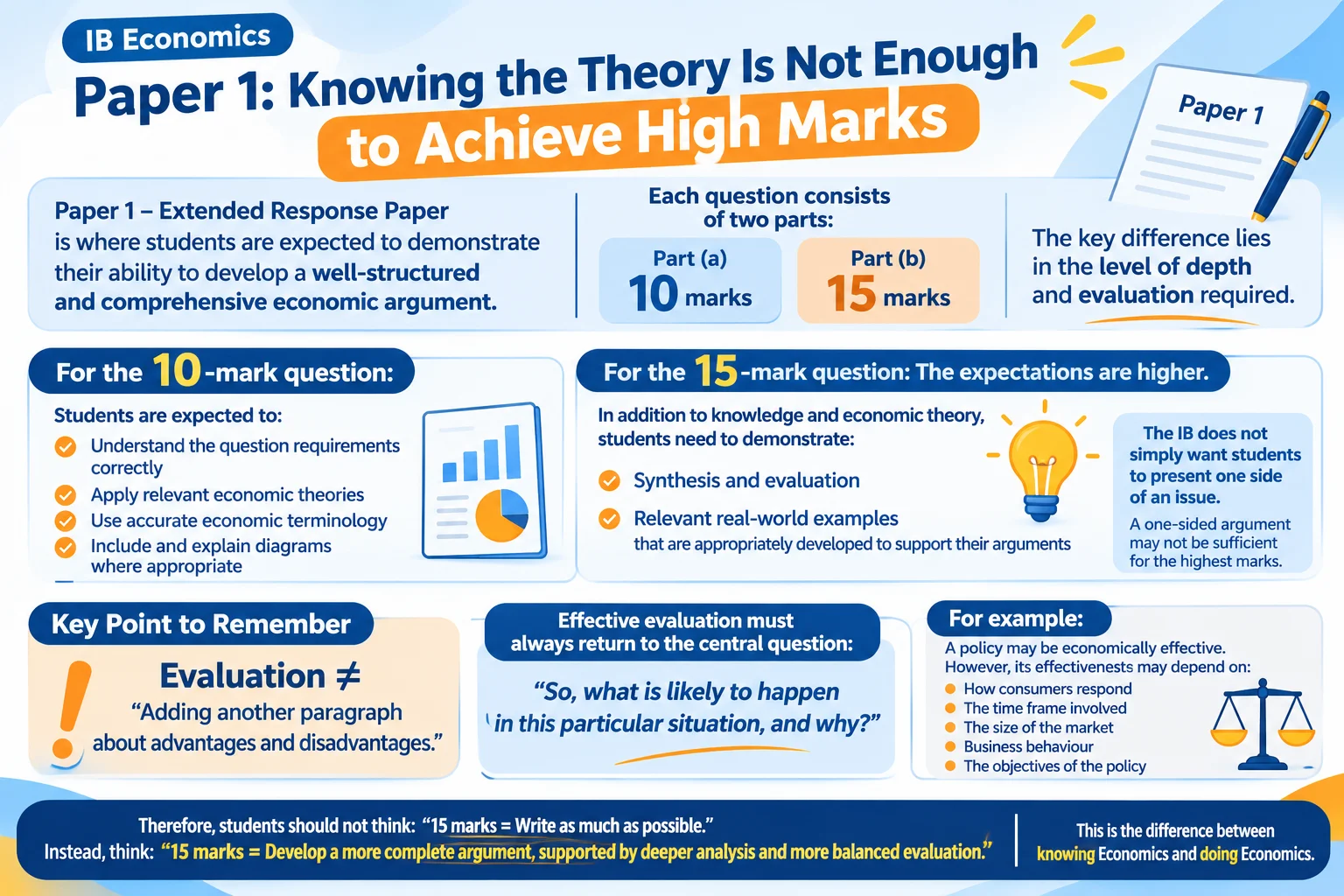
Paper 1 – Extended Response Paper is where students are expected to demonstrate their ability to develop a well-structured and comprehensive economic argument.
Each question consists of two parts:
Part (a) – 10 marks
Part (b) – 15 marks
The key difference lies in the level of depth and evaluation required.
For the 10-mark question:
Students are expected to:
- Understand the question requirements correctly;
- Apply relevant economic theories;
- Use accurate economic terminology;
- Include and explain diagrams where appropriate.
For the 15-mark question: The expectations are higher.
In addition to knowledge and economic theory, students need to demonstrate:
- Synthesis and evaluation;
- Relevant real-world examples that are appropriately developed to support their arguments.
The IB does not simply want students to present one side of an issue. A one-sided argument may not be sufficient to achieve the highest marks.
Here is an important point to remember:
Evaluation ≠ “Adding another paragraph about advantages and disadvantages.”
Effective evaluation must always return to the central question:
“So, what is likely to happen in this particular situation, and why?”
For example:
A policy may be economically effective.
However, its effectiveness may depend on several factors, including:
- How consumers respond;
- The time frame involved;
- The size of the market;
- Business behaviour;
- The objectives of the policy.
Therefore, students should not think:
“15 marks = Write as much as possible.”
Instead, they should think:
“15 marks = Develop a more complete argument, supported by deeper analysis and more balanced evaluation.”
This is the difference between knowing Economics and doing Economics.