SERIES: IB ECONOMICS DECODED_PART 3
IB Economics SL – Standard Level vs HL – Higher Level: What Are the Differences?
IB Economics SL – Standard Level vs HL – Higher Level: What Are the Differences?
One question parents and students often ask is:
“Is HL simply SL with more content to learn?”
Not quite.
HL (Higher Level) is not just about covering additional content.
More importantly, it requires a greater depth of thinking and a higher level of evaluation.
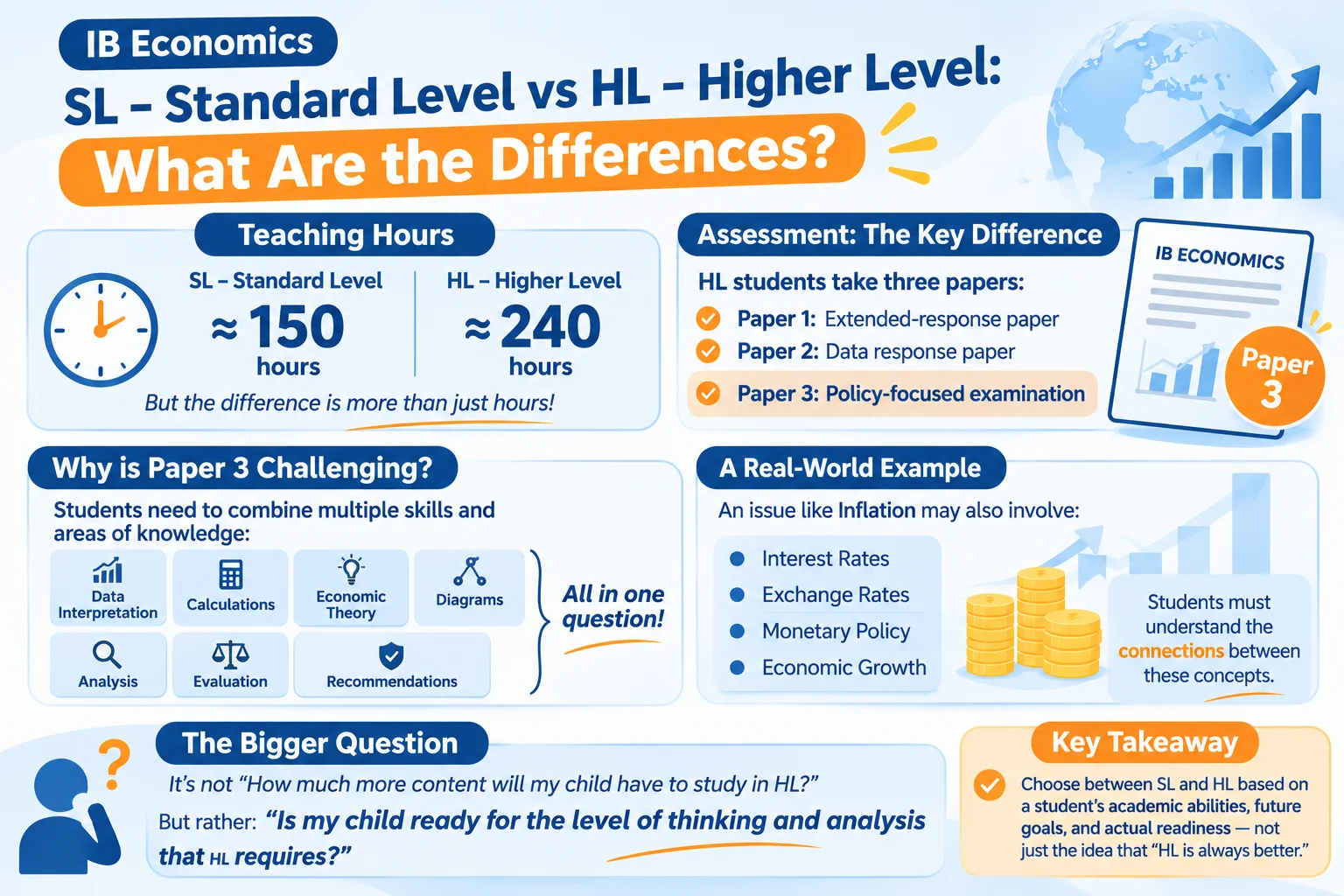
First, let’s look at the difference in teaching hours:
SL – Standard Level: approximately 150 hours
HL – Higher Level: approximately 240 hours
However, the number of teaching hours is only the most visible difference.
The more significant difference lies in the assessment requirements.
For HL students, the assessment includes:
Paper 1: Extended-response paper
Paper 2: Data response paper
Paper 3: Policy-focused examination
Among these, Paper 3 is a particularly important distinguishing feature.
Paper 3 challenges students with questions that require them to combine several skills and areas of knowledge, including:
- Data interpretation;
- Calculations;
- Economic theory;
- Diagrams;
- Analysis;
- Evaluation;
- And, most importantly, recommending appropriate economic policies.
Why is Paper 3 challenging?
Because students cannot simply study each topic in isolation. A single economic scenario may require them to connect knowledge from several different areas.
For example, an economic issue involving Inflation may also require an understanding of:
- Interest rates
- Exchange rates
- Monetary policy
- Economic growth
Students must be able to understand and explain the relationships between these concepts, rather than simply define each one individually.
Therefore, the more important question is not:
“How much more content will my child have to study in HL?”
But rather:
“Is my child ready for the level of thinking and analysis that HL requires?”
A student may work very hard to memorise economic knowledge but still struggle with HL if they are not yet confident in their ability to:
- Interpret data;
- Perform calculations;
- Explain economic relationships;
- Develop well-structured arguments;
- Evaluate economic policies;
- Draw balanced and qualified conclusions.
This is why choosing between SL and HL should be based on a student’s academic abilities, future goals, and actual capacity to manage the demands of the course, rather than simply assuming that “HL is always the better option.”