TOK — AREAS OF KNOWLEDGE (AOKs): THE FIVE CORE AREAS THAT SHAPE TOK
TOK — AREAS OF KNOWLEDGE (AOKs): THE FIVE CORE AREAS THAT SHAPE TOK
“How do we know what we know?”
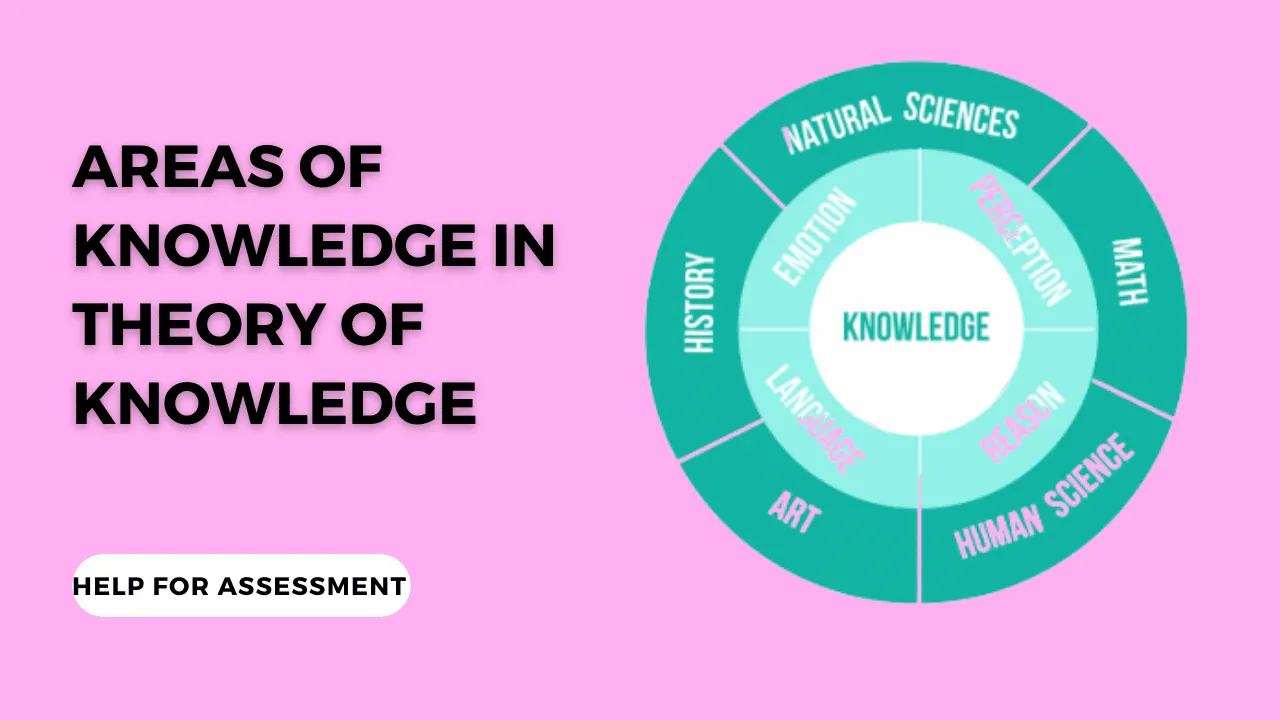
The answer depends largely on the Areas of Knowledge (AOKs) — the five main areas of knowledge explored in Theory of Knowledge (TOK).
1. HISTORY — Is Historical Knowledge Truly “Objective”?
Sources of knowledge: Documents, records, evidence and the perspectives of those who tell historical accounts.
Key issues to explore:
- History is always subject to interpretation. Two historians may present different accounts of the same event.
- “Who writes history?” can be just as important as “What actually happened?”
Suggested Knowledge Question (KQ): “History is a combination of evidence and interpretation — can it ever be completely objective?”
2. HUMAN SCIENCES — Can Human Behaviour Be Predicted?
Sources of knowledge: Surveys, experiments and behavioural data.
Key limitations:
- Human behaviour is inherently complex.
- Many variables are difficult to control.
- Ethical considerations place limits on experimentation.
Suggested Knowledge Question (KQ): “Models of human behaviour can identify patterns and trends, but can they ever guarantee accurate predictions?”
3. NATURAL SCIENCES — Is Scientific Knowledge Permanent?
Sources of knowledge: Experiments, observations, hypotheses and theories.
Strength: Replicability helps make scientific findings more reliable and objective.
Limitation: Scientific knowledge can change when new evidence emerges. For example, models of the universe have evolved significantly over time.
Suggested Knowledge Question (KQ): “Scientific knowledge is powerful because it can change — not because it remains unchanging.”
4. THE ARTS — Can the Arts Produce Knowledge?
Sources of knowledge: Emotions, personal experiences and individual interpretations.
What TOK explores:
- The arts can reveal ways of understanding the world, values and social perspectives.
- A work of art can communicate a distinctive form of knowledge that may not be measurable through scientific methods.
Suggested Knowledge Question (KQ): “Knowledge in the arts may be subjective, yet can it also have universal significance?”
5. MATHEMATICS — Is Mathematical Knowledge the Most Certain Form of Knowledge?
Sources of knowledge: Logic, proofs and axiomatic systems.
What makes mathematics distinctive?
- Once a proposition has been proven, it remains true within the system in which it is established.
- However, the choice of axioms itself involves human decisions.
Suggested Knowledge Question (KQ): “Does certainty in mathematics come from the real world, or from the systems we construct?”
Would you like Sarah Education to help you choose a suitable TOK topic? Send us a message to receive guidance from our team of specialists!