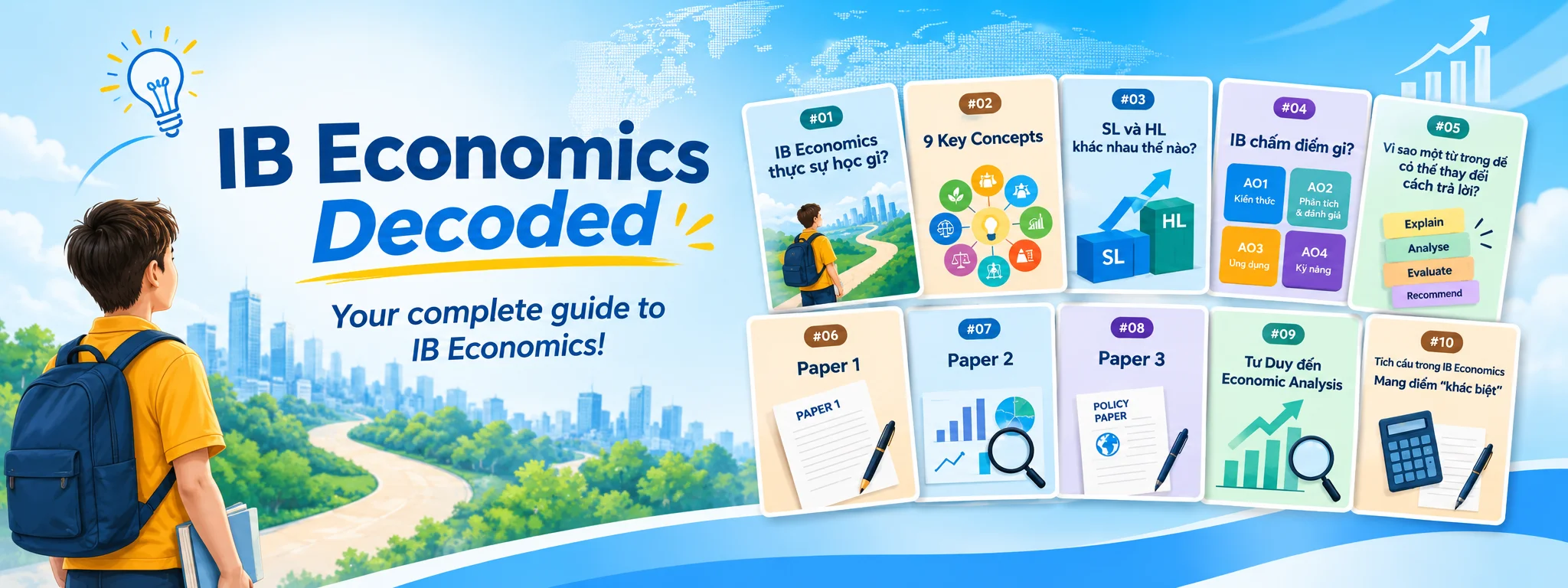
SERIES: IB ECONOMICS DECODED_PART 2
The 9 Key Concepts: Why Is IB Economics About More Than Memorising Definitions?
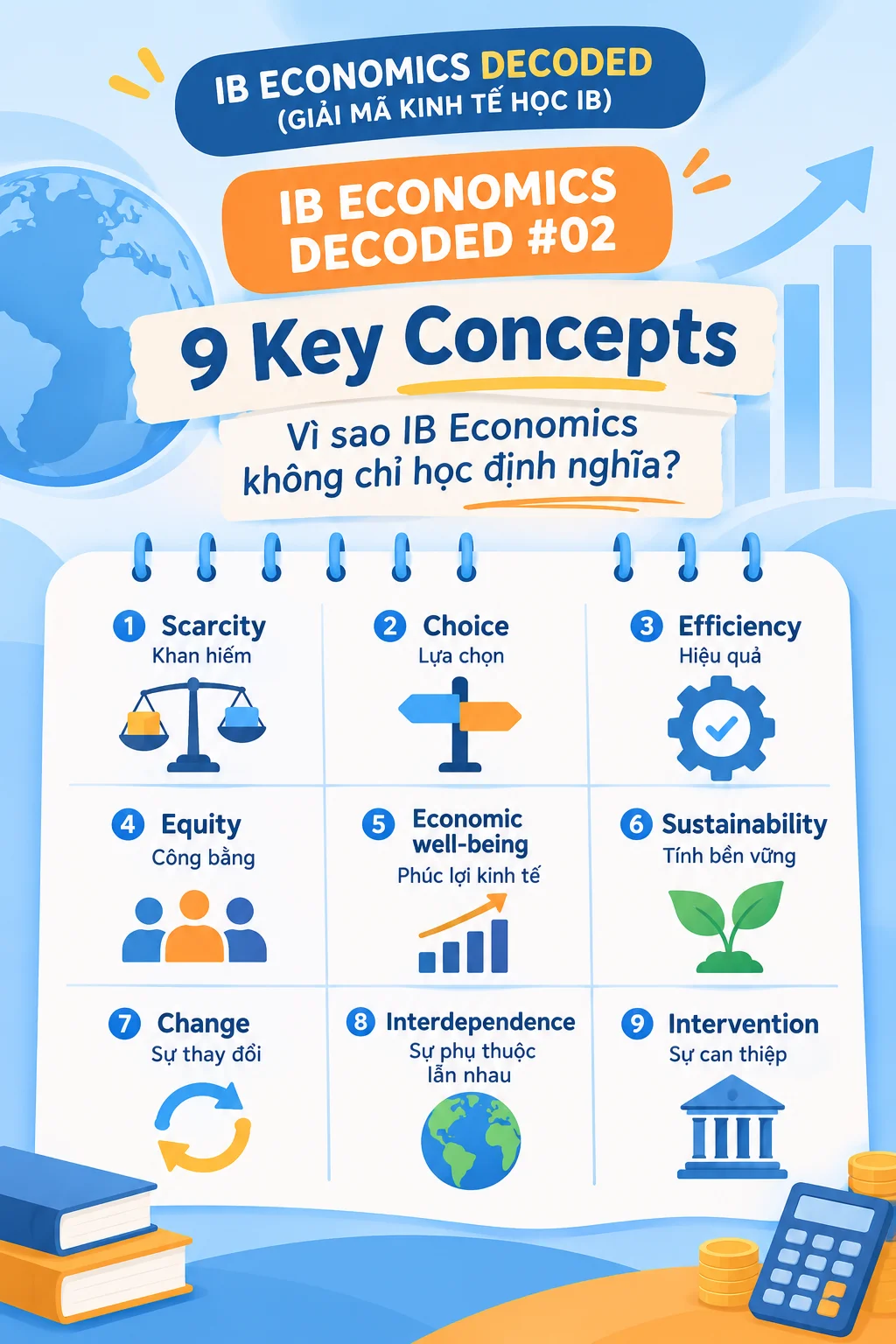
The 9 Key Concepts: Why Is IB Economics About More Than Memorising Definitions?
One of the most distinctive features of IB Economics is its emphasis on the Key Concepts.
The curriculum is built around nine key concepts:
- Scarcity
- Choice
- Efficiency
- Equity
- Economic well-being
- Sustainability
- Change
- Interdependence
- Intervention
But there is one important thing to understand: these Key Concepts are not simply nine definitions for students to memorise. Instead, they serve as nine different lenses through which students can examine and understand economic issues.
For example:
Imagine a government introduces a carbon tax. If students approach this topic through memorisation alone, they might simply answer: “A carbon tax is a type of tax.”
However, IB Economics encourages students to think more critically and explore the issue from different perspectives:
Intervention: Why does the government need to intervene in the market?
Efficiency: Can the tax help address the inefficient allocation of resources?
Equity: Who will bear a greater share of the tax burden?
Sustainability: Will the policy help reduce environmental impacts in the long term?
Economic well-being: How will the policy affect the lives of individuals and the operations of businesses?
This is why an Economics question can involve multiple layers of thinking.
For example:
Should the government increase taxes on a polluting product?
The answer is not simply: “Higher taxes lead to higher prices.”
Students should also understand the economic mechanism:
Higher prices → Lower quantity demanded → Lower output → Reduced pollution
But the analysis should not stop there. Students also need to consider:
- Will consumers be negatively affected?
- Will businesses face higher operating costs?
- Will lower-income households be disproportionately affected?
- Are there alternative policies that could be more effective?
- Could the policy produce any unintended consequences?
This is where Key Concepts become tools for economic thinking, rather than just a list of technical terms.
For students:
Instead of simply asking:
“What is the definition of this Key Concept?”
Try asking:
“What aspect of this issue can I better understand through this Key Concept?”
For teachers:
When teaching a particular topic, consider introducing additional questions to encourage deeper thinking:
“What if we examine this issue from the perspective of Equity?”
“What if we look at it through the lens of Efficiency?”
“Is there a role for government Intervention?”
“Are the short-term and long-term impacts the same?”