SERIES: IB ECONOMICS DECODED _PART 4
What Does IB Economics Actually Assess?
What Does IB Economics Actually Assess?
There is one important question that is sometimes overlooked:
What skills and abilities does the IB assess students on?
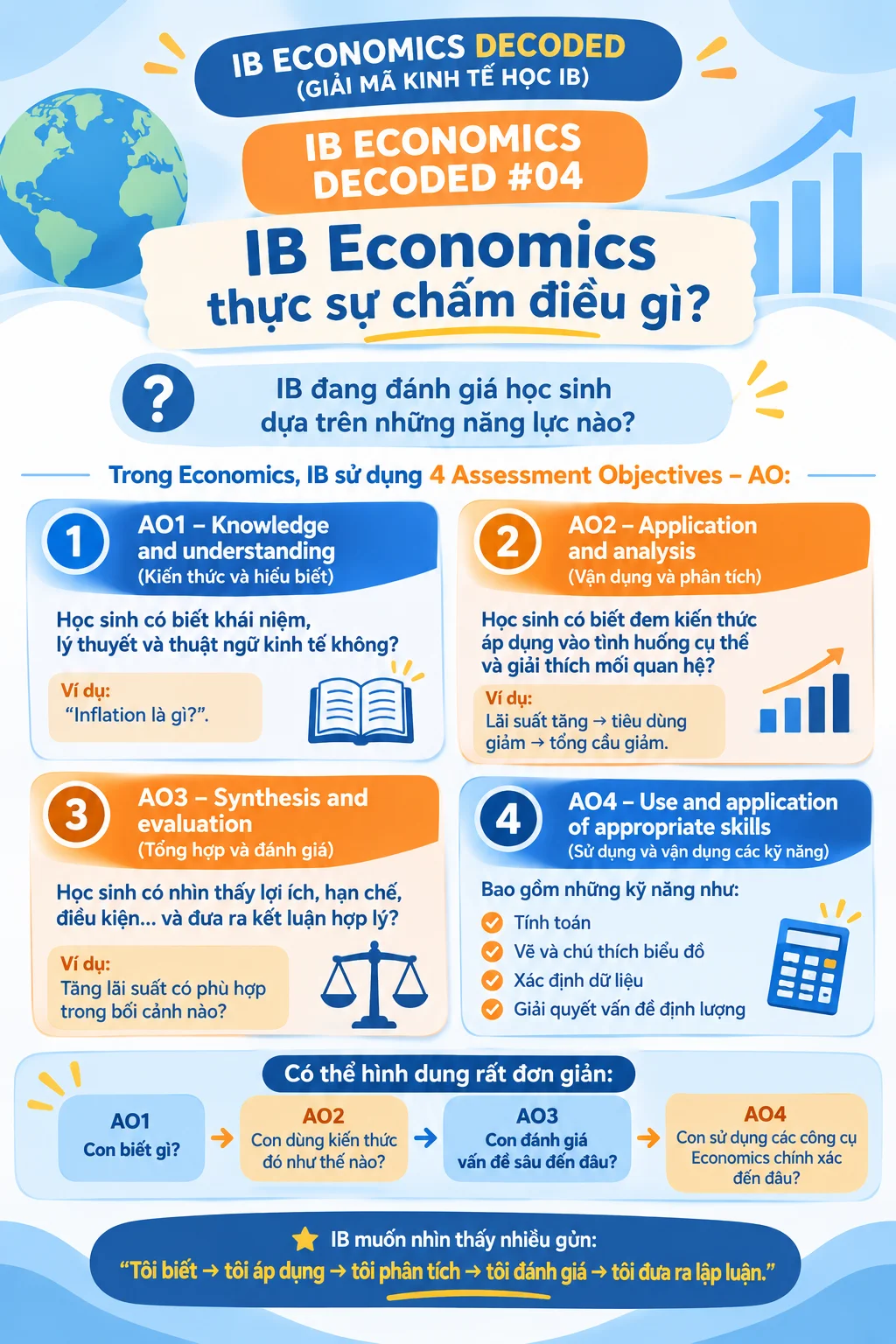
In Economics, the IB uses four Assessment Objectives (AOs) to evaluate students’ knowledge, understanding, and skills.
1. AO1 – Knowledge and Understanding
Does the student understand economic concepts, theories, and terminology?
For example:
“What is inflation?”
This is the foundation of economic knowledge.
2. AO2 – Application and Analysis
This is a more advanced step. Can students apply their Economics knowledge to specific real-world situations and explain the relationships between different economic factors?
For example:
Students should not simply state: “Interest rates increase.”
Instead, they need to explain the chain of economic effects:
Higher interest rates → Higher borrowing costs → Potential decreases in consumption and investment → Lower aggregate demand → Reduced inflationary pressures.
This is what analysis involves.
3. AO3 – Synthesis and Evaluation
Can students identify and consider:
- Benefits;
- Limitations;
- Relevant conditions;
- Different impacts;
- Trade-offs;
and use these considerations to reach a well-reasoned conclusion?
For example:
Raising interest rates may help reduce inflation.
However:
It may also discourage investment and slow economic growth.
So, the key question becomes:
Under what circumstances would this policy be appropriate?
This is the essence of evaluation.
4. AO4 – Use and Application of Appropriate Skills
This objective covers practical Economics skills, including:
- Performing calculations;
- Drawing and accurately labelling diagrams;
- Identifying and interpreting data;
- Solving quantitative problems.
A simple way to understand the four Assessment Objectives:
AO1: What do you know?
↓
AO2: How do you apply that knowledge?
↓
AO3: How deeply can you evaluate an issue?
↓
AO4: How accurately can you use appropriate Economics tools and skills?
This is why an essay containing a large amount of economic knowledge does not necessarily achieve a high mark.
If students stop at demonstrating that “I know a lot”, they are mainly showing evidence of AO1.
The IB expects much more:
“I know → I apply → I analyse → I evaluate → I develop a well-reasoned argument.”
This is one of the key principles to understanding how to study and succeed in IB Economics.