SERIES: IB ECONOMICS DECODED_ PART 5
What Is the Difference Between "Explain", "Analyse" and "Evaluate"?
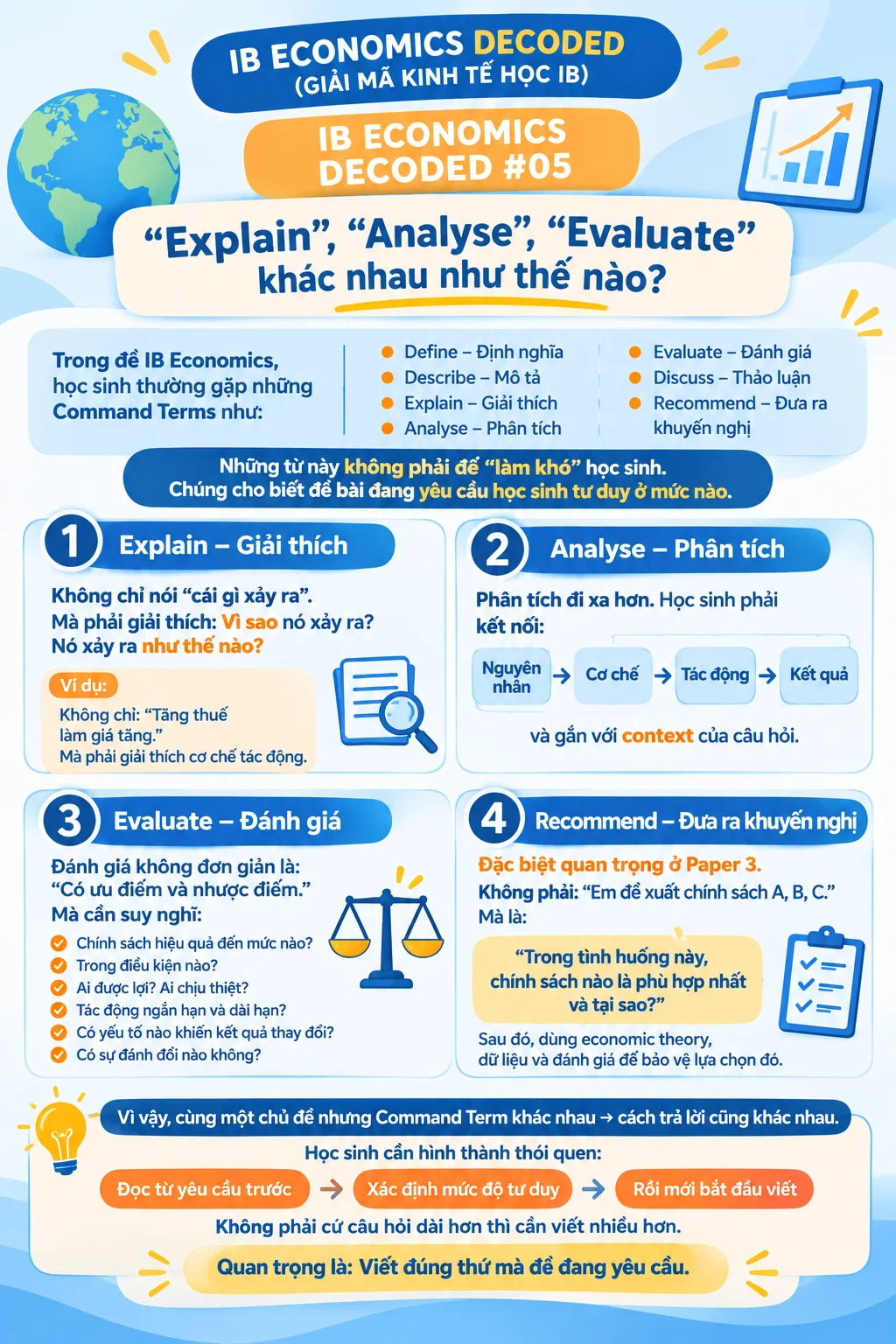
In IB Economics exam questions, students frequently encounter Command Terms, which indicate what the question requires them to do. Common examples include:
- Define
- Describe
- Explain
- Analyse
- Evaluate
- Discuss
- Recommend
These terms are not intended to make questions unnecessarily difficult.
Instead, they indicate the level and type of thinking students are expected to demonstrate in their answers.
1. Explain
Students should go beyond simply stating what happens.
They need to explain: Why does it happen? How does it happen?
For example:
It is not enough to state: “An increase in taxes leads to higher prices.”
Students must explain the economic mechanism through which the tax affects prices.
2. Analyse
Analysis takes students a step further. They must establish clear connections between:
Cause → Mechanism → Impact → Outcome
These connections must also be applied to the specific context provided in the question.
3. Evaluate
This is where many students find things challenging.
Evaluation is not simply about stating that something has “advantages and disadvantages”.
Instead, students need to consider questions such as:
- How effective is the policy?
- Under what conditions would it be effective?
- Who benefits?
- Who is negatively affected?
- Do the short-term and long-term impacts differ?
- Are there any factors that could change the outcome?
- What trade-offs might be involved?
4. Recommend
This is particularly important in Paper 3.
The task is not simply to say: “I recommend policies A, B and C.”
Instead, students must answer:
“Given this particular situation, which policy would be the most appropriate, and why?”
They must then use economic theory, relevant data, and evaluation to justify and support their recommendation.
Therefore, even when the topic is the same, different Command Terms require different approaches to answering the question.
Students should develop the habit of:
Identify the Command Term first → Determine the required level of thinking → Then begin writing.
A longer question does not necessarily require a longer answer.
What matters most is:
Answering exactly what the question is asking you to do.